by Ricky Toledano
We jostle in boyish play all the way down the street until the corner, where our more than twenty-year age difference becomes forty. I morph from an old man to a very old man because it is nighttime and there is neither crosswalk nor stoplight. I have a vision problem whereby I cannot judge the distance of headlights. They confuse me, and I cannot cross the street alone. Dheeraj knows this, and he leads me by the hand.
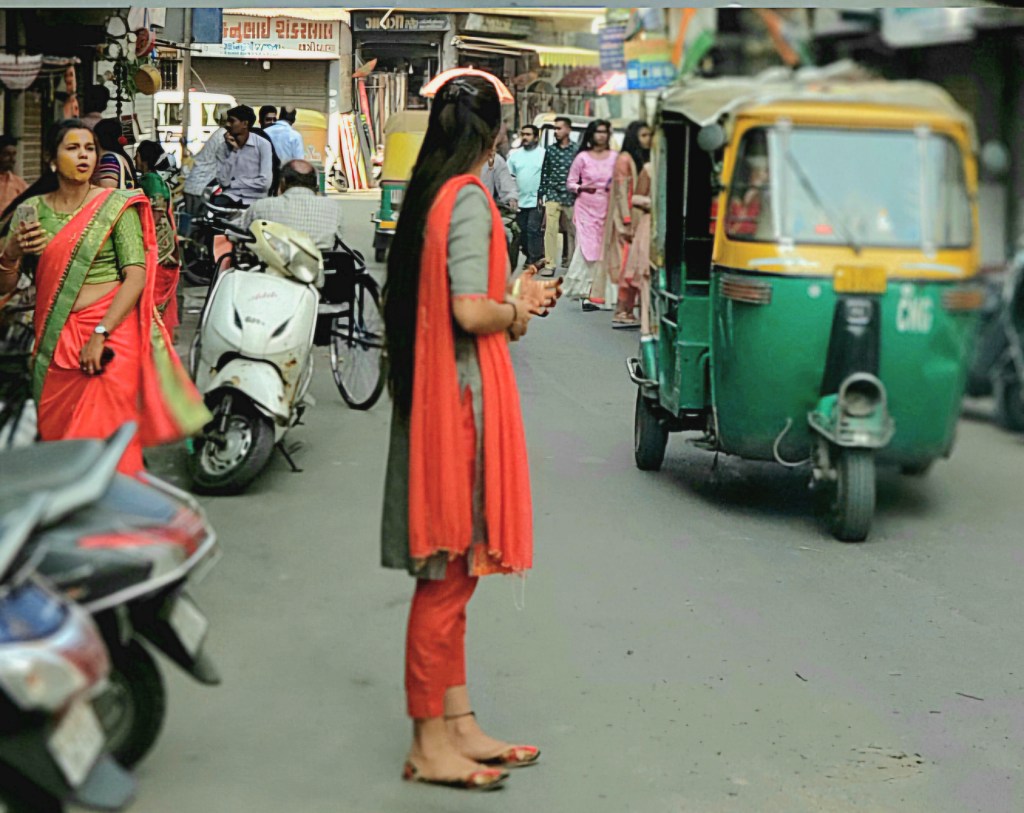
Here in India I understood the meaning of the expression “like a deer caught in the headlights”. Not only did the traffic flow in the opposite direction of the Americas, but it was also unorganized. Or at least I couldn’t identify an order. I used to freeze before the chaos.
But that was a long time ago. Since then, not only have I learned how to cross the street in India, but I have also learned that there is no such thing as chaos. Just because one cannot see the Order at work doesn’t mean it isn’t there. Today I see it. And when I don’t, I have the faith that it will be revealed to me.
I could never have imagined that the Order would send me to India, nor that I would spend so much time here over the years. The culture has become so much a part of me that, today, walking the streets, nostalgia sprouts as I miss that feeling of wonder when I first arrived.
At night, however, I return to bewilderment and I still cannot cross the street. I trust Dheeraj, so I just look at the pavement below me and ignore the swarming evening traffic. I hold my breath until we dive into the vegetable stall on the other side of the road to get his mother’s shopping list. I had repeated it to her in Hindi: gobi, aloo, dhanya, pyaaz… Cauliflower, potatoes, cilantro, onions…
Inside, the evening shoppers from the neighborhood try not to stare at me, a foreigner they might encounter in the more cosmopolitan areas of Bengaluru, but not in residential Banaswadi, one of the many villages swallowed by the megapolis. I catch a few souls trying to be discreet when looking at me and I smile at them. Their faces open up like flowers to say hello.
There is a black rabbit chewing string beans that have fallen on the scruffy floor. Then I spot another rabbit, fleeing a squealing child while perusing fallen vegetables. There are mounds of gourds and eggplants I have only ever seen in India. I pick through the tomatoes, but it is not easy. I have the same problem with poor quality tomatoes at home. They come from the same seeds sold around a globalized world. And in globalized world, Dheeraj just wiggles his phone to pay and we leave.
As a well-mannered youngster, Dheeraj insists on carrying the bags for his elders, but I snatch the heavier one. I insist on using my body at every opportunity. Dheeraj knows this too, and over the years he has ceased to assert himself. I do not, however, lose the opportunity to mock grievances:
“You see!” I fake-shout from behind him, carrying a full load, “I have to do everything! Everything! You only care about yourself! Selfish!”
He chuckles as we swerve around a cow sleeping in the sand of the broken sidewalk. I give him a hard slap on his back. He is strong and solid, and the thud reverberates to make passersby laugh.
“I do everything for you!” I continue, “But you do nothing for me! I pay for everything! I carry everything! Then I cook for you! And you? NOTHING!”
He hisses laughter and squints as he flashes me a smile. I cannot help but parody the recent family row—no different than any other in the world—an earthquake followed by aftershocks, waves of recriminations in which everyone reveals their resentment ledgers. I am always amazed at how, as humans, we are so bad at bookkeeping: we fill in the column of our contributions but not those of others. We cross the world, we speak different languages, we have different cultures, but nothing changes: we only see the debts the world owes us, not our own—to say nothing of recognizing the assets we have been given. It is always the same stupid fight in every human relationship.
The evening traffic is intense and smoggy. There are many of the iconic street dogs on the roadside, but I finally identify a novelty on the streets when I keep noticing dogs on leashes. A smiling husky sniffs me as I step around it. The sidewalk is intermittent and we return to walking on the road alongside traffic.
“Dheeraj, what is this thing with pets now?” I ask. “I never saw pets before!”
“Bhai, it was what we were talking about,” he replies, “In this New India, people are lonely and children are expensive. Pets are easier. They don’t come with grievances.”
“You are becoming just like us in the West,” I say. “Soon you will lose the ability to talk to each another and think it is just normal to shoot, stab and rob one another in the street.”
Dheeraj shrugs.
Hmmm, I think. Curiously, I hadn’t noticed the pet mania last year. It doesn’t seem possible that this new phenomenon could have sprung—complete with the pet shops I have seen even in villages—in just my one-year absence. Is it part of the Order that we are meant to see things at a certain time and place?
I also think about my resentment ledger. In the debit column: the fact that I fear walking on the street in my home city of Rio de Janeiro, and it is not because of oncoming traffic at unmarked corners—if only it was! Yesterday, while on the smartphone that I cannot seem to put down even when on vacation (Actually, I discovered we need our stupid smartphones even more when on vacation!), I saw that passengers aboard the subway in Rio de Janeiro had been robbed at gunpoint. I explain to Dheeraj that the metrô had always provided respite in a dangerous city. I wonder if a new normal has begun without anyone taking notice, the way I must have not seen the pet shops last year in India.
Two years prior, I was visiting my hometown of Chicago when I realized how absence provides the distance to see with clarity. Some years had passed since I had felt the cold bite of winter in the city. The streets felt as safe as I remembered, but I was surprised by a new normal when taking the city’s main metro line. It was filled with people who have been abandoned like dogs on the street, fallen through the cracks to become the smelly, inconvenient mental health cases everyone wishes would vanish. In the winter cold, they were riding the train not as transport but as residence. It made me think about what I had done wrong; what we have done wrong as a society that adapts to lower levels of the unbelievable.
“So if nowhere or nobody is to my liking or the way that I want it, the problem must be me, right?” I ask Dheeraj, challenging him to analyze what had happened in the most recent family feud that I had been mocking.
“Ha! That’s it!” He says, “The problem is we lash out. The problem is always others, not us.”
I tell him about the pressure cooker I heard in the morning. His mother was preparing rajma, red beans—she spoils me with my favorites! The pressure cooker began to whistle. I was thinking about what happens when we don’t hear the whistles. The warnings.
“We explode like a bomb,” I say. “Better to release steam little by little. You waited too long to set the limit and look at what happened. Everyone exploded and started pointing fingers.”
That afternoon I had been licking my fingers. The red beans and rice, together with his mother’s chapatis, were perfection. The imperfection was the family not eating together. They were still sulking, waiting for the storm to pass. I told Dheeraj not to fear storms, face them. They come and go; they might knock down trees, but they make way for new ones.
When we arrived with the vegetables in the evening, I refused dinner (something that is not easily done). I was still full of red beans and rice, but actually I was also not feeling well after a day when the sun had not come out. The air had a grey thickness I remember from the opposite end of the country.
On the television, the national news was showing the horrendous situation of Delhi, where the air quality index has flown off and beyond metric scales. On a normal day, the city is the world’s most polluted. In the wintertime, it becomes a gas chamber. I had spent enough winters in Delhi to remember the feeling of malaise: lethargic and unable to think clearly. Then, my lungs and sinuses started to itch and hiss before they took over my mind.
Bengaluru does not have the air pollution problem of Delhi, but on the day we went to get the vegetables, it was bad. I could see and feel the future of the city—the future of the world. It refutes any logic other than profit as its organizing force. In all countries, everywhere, we are afraid to slam the brakes on consumption, so we keep polluting, because we know what will happen if we come to a full and sudden stop. I’d seen it a week earlier in the South.
We had driven 800km to reach the city of Varkala when the autorickshaw in front of us slammed the breaks to avoid hitting a dog. For those of you who do not know what this vehicle is, it is basically a motorcycle converted into the iconic, open, green and yellow taxis that do short runs in cities all over India. The brakes were stronger than the vehicle and it flipped. The momentum hurled the vehicle on its side. The driver and his two passengers—two elderly nuns—hit the pavement without any protection.
All traffic stopped and we sprung from the car to help. The driver managed to get out, but the elder sister most certainly fractured her skull. She was bleeding and barely conscious on the ground inside the autorickshaw. Blood had splattered their gray habits. The crowd managed to lift the younger sister to her feet. She stood up through the door. Dazed, she was holding her head with both hands.
I will never forget her look of wonder, nor her silence: there was no scream, no wail, no cry, no emotion. Then she held her crucifix, the tool she used to understand the Order around us, inside us. There is no place that it is not. Her eyes were fixed on me. Was it because I had such a different face from everyone in the crowd? Or did she see me with a tear in my eye and my palms pressed together? Did she recognize the same faith in the Order that she had?
A few others joined me in begging the crowd not to attempt to turn the autorickshaw upright, nor to haul the nuns out. In desperation to help, some could not resist the temptation, because the autorickshaw is so open and light. I saw it as awkward and delicate. One wrong move and the tragedy could worsen.
“Wait for Emergency Services! Please!” I shouted.
I had never seen such a fast response. Within a few minutes, the nuns were in the ambulance, and they were about to leave when the crowd stopped the vehicle. They insisted that the autorickshaw driver be admitted to hospital as well. The backdoor of the ambulance opened again and in he went. The street returned to its flow.
The crowd dispersed after everyone shook hands. A few people came to thank me; I didn’t understand why. I just put my hand over my heart and wagged my head. What to say? We were all rattled and amazed by the ebbs and flows of the universe that had brought us together in one place, for one moment. How? Why?
I don’t know. But it certainly painted a picture in my mind: slamming the brakes was a tragedy for the nuns, but a blessing for the dog. It had darted off with not so much as a yelp, unaware of any misfortune it had caused.
I tell Dheeraj how the nations of the world met in Brazil last month for the COP30—the thirtieth attempt to discuss a plan about what to do about our environmental fiasco. The nations went with their resentment ledgers in hand (if they even bothered to go), each demanding payment from others while refusing to record their own debts. Poor nations tallying rich nations’ pollution. Rich nations calculating poor nations’ future emissions. Everyone’s columns balanced against everyone else. They gripe that poor nations are bearing the brunt of the climate emergency that wealthy nations caused. Yet there are both rich and poor nation imposters. Some countries are about to disappear underwater; others are burning. No nations want to give up anything. They expect the other nations to relinquish growth. No one is willing to write themselves a deficit.
“They say that we will use capitalism to clean up the world that capitalism fudged,” I tell Dheeraj, “Making the environment profitable with a green economy. They were saying this before you were born. And now, Indians and Chinese want to consume like Americans. As long as profit is the priority, life will be negotiable. So many whistles have blown and little has changed.”
We just keep going and hope for the best, hoping for the worst: that we hit rock-bottom so that someone will finally save us; that the pressure cooker finally explodes to be taken seriously—because we’ve ignored every whistle, every warning. But I believe in human capacity to construct the bottomless pit. We tolerate new levels of the intolerable. That is why I fear that Bengaluru will become the next gas chamber.
I am sitting cross-legged, eating pomegranates and pistachios. There is an embarrassing mound of discarded shells. I must be a bottomless pit, I think. I could beat anyone at eating pistachios—except for Dheeraj. But we don’t compete; we cooperate.
Sitting comfortably at Dheeraj’s home after ten days on the road, I am having a deep think about the difference between competition and cooperation. I remember the African proverb: If you want to go fast, go alone; if you want to go far, go together.
For me, it describes the difference between the West and the East: the former insists on competing to enjoy quick results and applause while the latter has an unspoken plan for the long-term benefit of everyone. The seismic shift that has rocked geopolitics is that the West has already lost by competition. Now they are angry and want to change the rules to keep winning without cooperation. I find it particularly irrational that they insist on continuing the same game of growth that got us in this mess, where the very air I breathe is insupportable. Ironically, the West seems to think growth can happen without cooperation—alone, with dogs instead of children or immigrants, and without jobs for anyone now that there is AI. But since when are human beings rational? Emotion trumps logic. Hubris allows neither individuals nor nations to be wrong, to apologize, to stand corrected, to change or to sacrifice anything. How we cling to our precious.
I crack open shell after shell of pistachios and the visions of a road trip unfold. I recall the blue flash of a kingfisher hunting in the Keralan backwaters. I can’t believe all the territory Dheeraj and I covered, and I update the African proverb with another: Alone a youth runs fast, with an elder slow, but together they go far.
I remember the nun clinging to her crucifix without a word. I assume nuns understand the discipline of sacrifice better than most. That they have given up their precious for something greater. People like that are going to have to teach us how to cross the street. They see the Order where others only see chaos. Because if we stop now, we crash. Perhaps that’s what I’ve learned with Dheeraj leading me across dark intersections—to trust that the Order exists even when I cannot see it through the headlights.

 ā•multiplicity
Leave a comment