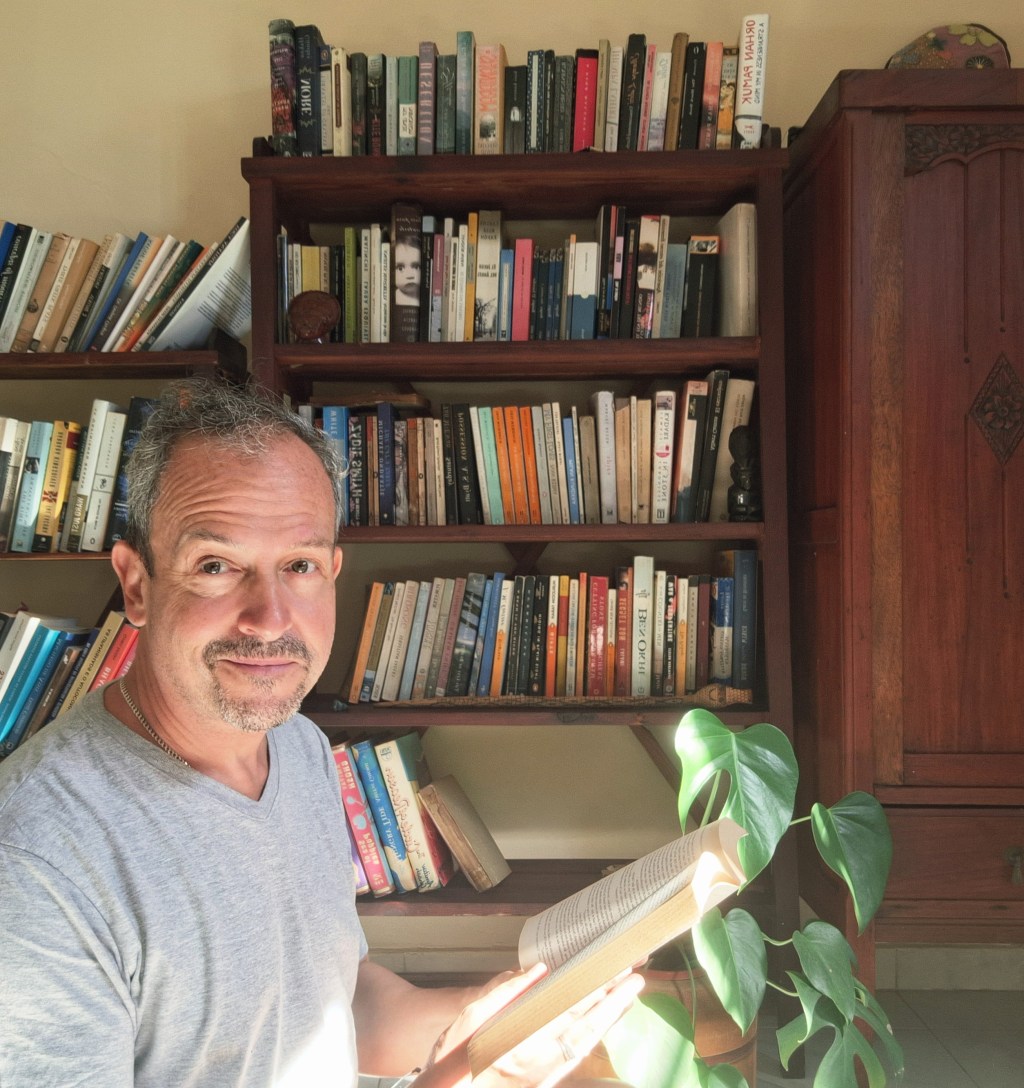
by Ricky Toledano
In 2025, I learned the difference between reading and hearing our favorite writers speak. It can undermine or uplift everything.
Years ago, I read a regrettable interview with a writer I greatly admire, a man who had been awarded literature’s highest honors. His novels had taught me much about the world, and they contributed to shaping my vision and work. I will not mention his name, because I do not wish to add any further kindling to the fire with which he burned his reputation—not that he cared. Years before it became fashionable, he was the kind of provocateur who enjoyed revealing his prejudices just for the controversy. One remark was particularly infelicitous about women writers. He had caused such a kerfuffle that I couldn’t avoid reading what must have been an interview about the interview. Halfway through it I thought, Please just shut up and write! Don’t open your mouth! Just write, you stupid windbag!
It won’t be difficult to use my 2025 reading list to do a better job than he did observing tendencies in the way the genders write, as well as to say something more constructive about writing through the windows of different cultures—his belief that he was an authority on the post-colonial world had also been unfortunate.
We expect so much from our writers. We assume they are intelligent and articulate, so we ask them for opinions. Being intelligent, however, does not mean that one is wise. I had always thought that a writer must be wise. It was a great disappointment to discover that an idol was so clumsy when speaking and so inept at seeing his mind at work—the minimum requirement of wisdom is to deal with emotions, with the ego.
I was traumatized after that experience and refused to read or listen to interviews with artists I admire—though really, it’s not necessary. A creation, just like a child, goes into the world to do surprising things that don’t have anything to do with the parents. In the last few years, however, I’ve given some creators another chance to speak.
One writer I admire had said in an interview that time is precious and he had to choose between reading and writing. He had already read so much that it was time for words to flow in the opposite direction. He wasn’t reading much.
That resonated with me, and I started writing and writing. Then recently, I’d been feeling low on fuel. I listened to a young and highly successful novelist whom I admire. In her country she, like me, is the child of an immigrant. Her second-generation vision of the immigrant experience and multiculturalism was like oxygen. Just like me, she wrote the way her people speak: long sentences, long paragraphs, digressions, and lots of italics. Everything today’s editors hate. In the interview, however, I was disappointed by her political opinions. They were more emotional than analytical. The idealism was cloying even when I agreed with her. Once again, I encountered a writer who had been granted authority to opine on a subject for which she hadn’t come prepared with much more than conviction. But then she slapped me in the face: If a writer is not reading, their writing will not be up to par.
In 2025, I accepted her challenge and returned to reading—a lot. Serendipitously, the words entered me, becoming a part of me, helping me to express the inland sea.
I read in three languages (brag!) but write in only one, despite occasional forays. Someone in the future is going to have to apply electrodes to my head to see how that toxic mix works, but I feel it’s for the powers of good. Sometimes I feel myself hitting walls when an idea comes to me in Portuguese or Spanish faster, sharper. Then I am painted into a corner, forced to find a way out: a well-known methodology for any writer.
In 2025, I curated my reading carefully. I wanted to read in all three languages. I wanted to catch up on both contemporary and classical writing. I also wanted to read both men and women. I wanted to return to writers I trusted. I wished to discover someone new. I forced myself into different corners.
First, a confession on taste: I am unattracted to American writers. It’s like sexuality: you know what you like and don’t like. It’s not a question of reason. I would love to be ‘total flex’, but since I was young, I’ve wanted to know about other worlds, not mine. I suffered in school reading the canon. I remember none of it.
Later, I tried to find something to like from the US. Despite my acute allergy to American tales of justice and courtroom drama, Truman Capote’s one-hit wonder, In Cold Blood, had been the only American novel that astounded me—until this year.
In 2025, I finally allowed James Baldwin to cut my reading line. Go Tell It On The Mountain offered such lyrical insight into human nature. The cadence! I can’t believe I hadn’t read it before, but books find us when we are ready. Now is a time when I think all Americans would benefit from taking a few days to become a young, gay, Black boy in Harlem in the 1930s. Come of age when your parents’ past in the Deep South comes to haunt you. Feel the generational psychological depth of religious repression, racism, and familial cruelty. If you are from urban America, like me, this timeless story will teach you much about the friction around you.
Two other contemporary North American writers were a great discovery. André Alexis and Aleksandar Hemon have the immigrant vision that is easiest for me to embrace, because they come from other worlds—my favorite position!
I’ve decided to despise Other Worlds: Stories by André Alexis. I hate him: I not only wanted to write that, but I wanted to write it that way! His prose is as flawless as it is unique. He brings you a magical world where a Trinidadian Obeah finds himself reborn in the body of a Canadian child a hundred years after his death. Then, a writer takes up a seasonal job as the caretaker of suspicious sacks hanging from the rafters of houses in a small town. A woman has an affair with the famous artist who painted portraits of her mother. A sealed envelope rewrites the tragic crime a woman committed at the age of six. Alexis plays and sings when showing how Old and New Worlds fit and will never fit.
Ditto for Love and Obstacles by Aleksandar Hemon, who shares the experience of a Bosnian, war-torn family splattered across North America with tragicomic acerbity. Nobody is where they want to be, where they thought they would ever be. There is joy, remorse and nostalgia for a world that collapsed, but didn’t: the novel-in-stories sings that world through the lapidary, ornate and surgical command of language that only immigrant writers acquire with a second language.
Both books ripped tears of joy from me as I read. The perspective of the outsider looking in touched memories of my father, a Mexican immigrant. I was a natural target for the cultural criticism in both books, but they are for anyone who has ever been left to fend for themselves in any new world. Alexis is a more generous cultural critic than Hemon, who shares a certain abrasiveness with me—as well as an intimate knowledge of my native Chicago.
In Spanish, I was curious to read one of the most important contemporary voices from Latin America. I chose Siete Casas Vacías (Seven Empty Houses) by the award-winning Argentine writer Samanta Schweblin. These stories of disquiet, boundaries, and obsession capture today’s world of strange people living in a strange world. Her prose is clinical, tense: there is a ghost, a fight, trespassers, a list of things to do before you die, a child’s first encounter with a dark choice, and the fallibility of parents.
Since he won the Nobel Prize in 2021, I had promised to revisit Abdulrazak Gurnah. I chose Paradise, an earlier work. I immediately recognized the voice from Desertion. Set in early 20th-century East Africa (Tanzania), just before and during World War I, the novel follows Yusuf, a young boy pawned by his father to settle a debt. He becomes a servant to a merchant named Aziz, and the narrative traces Yusuf’s journey into the African interior on trading expeditions.
What to say? Nobody can tell a story like an African! You will get schooled, not only about the use of language but also about life, because he can do so much more with less.
I revisited another Nobel favorite, J.M. Coetzee, with The Pole. The book reads like an extended meditation full of the ruminating questions of Witold, an “extravagantly white-haired” Polish pianist, and of Beatriz, a stylish patron of the arts who helps organize his Barcelona concert. Although Beatriz, a married woman, is initially unimpressed by the elderly Witold, she cannot understand why she is falling for his letters and invitations to travel, including to her husband’s summer home in Mallorca. Their unlikely relationship unfolds, but only on her terms. The power struggle between them intensifies as infatuation meets compassion in an unpredictable conclusion. For me, Coetzee’s latest is a beautiful meditation on how romance is a dialogue with oneself, lost in translation, as well as on how to envision the future when one is at the end of one’s life.
The Panchatantra was composed in Sanskrit around 200 BC and is attributed to Pandit Vishnu Sharma. I could never get through the winding animal fables-within-fables that alternate between prose narrative and abrupt verse maxims until I found the Penguin Classic. Many of the fables we think of as Aesop’s or from The Arabian Nights have their origin in The Panchatantra, “the five books.” They turn the reader into a prince and prepare one for the statecraft of life with practical wisdom: shrewdness, caution, the importance of good counsel, and how to survive in a world of predators—not simple moral lessons. The stories demonstrate human psychology—greed, fear, ambition, loyalty, betrayal. Characters are rarely purely good or evil. The monkey and the crocodile; the lion and the jackal; the brahmin and the mongoose: the stories are morally complex and often cynical. Sometimes cleverness wins, sometimes it leads to disaster. It is an entire school for all ages.
In 2025, the Portuguese language stole the show with two books that exemplified how men and women can, but do not necessarily, write differently.
Miguel Tavares Souza from Portugal is an old favorite. I have read most of his novels. I smiled as I read the very first paragraph of Último Olhar (not yet translated to English, but you can find others equally good to choose from). It opened with that large, comfortable, perfectly carved welcome sofa where one sits to enjoy the show—the Latin style in which Gabriel García Márquez taught all of us how to welcome a guest. A master, he served a buffet: the Pandemic, the Spanish Civil War, the difference between passion and love, and how we never know when it is the last time we see another.
Tudo é Rio (It’s All River) by Carla Madeira was a Brazilian bestseller. Who wasn’t raving about it? At the door, the reader is walloped by the enormously proud Lucy, the town’s most deviant and coveted whore. She is lusted after by everyone she meets, but she is captivated by Venâncio, the somber carpenter with a dark secret. Venâncio is married to Dalva, his teenage sweetheart. The couple was once the epitome of matrimony to all their neighbors—until a tragedy left them estranged in their own home. Mad with desire for Venâncio and obsessed with Dalva, Lucy makes a decision that forever intertwines their three lives. The talent and maturity of such a young writer—her ability to see how betrayals can be part of a larger story one cannot yet comprehend—was indeed impressive.
The intimacy of the novel is as hypnotic as its lyrical prose. Its poetry leads the reader, illuminating the path with sensory details. The sensuality in her voice is a trait I have often found and admired in women writers. It differs from Tavares Souza, who gives us a sweeping novel of individuals caught in the tide of history.
That said, I can think of so many exceptions to the supposed tendency of women novelists focusing more on interior psychological life and relationships, while men favor external action, ideas, and public/political spheres. These are stereotypes that reflect historical constraints and critical biases more than actual writing differences, and countless major writers defy these categories entirely—including the abovementioned Madeira and Tavares Souza, who have demonstrated in their respective books their intimate, compassionate knowledge of a different sex through such sculpted characters.
So this is what a year of intentional reading taught me: that the unnamed writer from my opening paragraph—the one who burned his reputation with careless pronouncements about women and post-colonial literature—was not only wrong but lazy.
I read books not on this list. Reading widely across genders, languages, and cultures in 2025 showed me that any claims about how men or women “naturally” write crumble under the weight of actual books. What I found instead were individual voices: some expansive, some intimate, some spare, some lush. Some men write with devastating psychological interiority. Some women command epic historical scope. The best writers transcend these tired categories entirely, or move fluidly between them, or ignore them altogether.
The real difference isn’t between male and female writers—it’s between writers who approach other worlds with curiosity and humility, and those who approach them with presumption.
That writer I once admired could have shut up and written. Instead, he spoke and diminished himself. As for me, I’ll keep reading. There are too many worlds I haven’t visited yet, too many voices I haven’t heard. In 2026, I’ll read even more. The inland sea is vast, and these words—from Baldwin’s Harlem, from Hemon’s Bosnia, from Gurnah’s Tanzania, from Madeira’s Brazil—are still flowing in, still becoming part of me, still teaching me what I don’t yet know how to say.
 ā•multiplicity
Leave a comment