
photos and text by Ricky Toledano
The serendipity in the encounter with graffiti street art has always halted me, arresting my eye. It is as if a message had been abruptly slipped into my hand from a stranger who then ran off and whose face I never got a chance to see. What is left is an urgent message from my surroundings, a message with much more meaning than given credit. I had spotted one such message, once, on a scavenger hunt for a Chicago that no longer exists. At a conspicuous height above an awning where it might have been overlooked as a large doodled poster, closer examination revealed the line sketch of a tired face with bags under the eyes so severe they were layered, or they might have represented tears. It had the stark caption “Get a haircut. Get a white shirt. Get a tie. Get a job. Get married. Die. Repeat.”
“Well, what’s the problem with that? That is just how life is! I’ll drink to that!” said a cynical younger brother, who would never lose an opportunity to deride any concerned observation of mine. I had been trying to explain to him how I found the message much more ironic for its location rather than its content. It was placed opposite the sophisticated restaurant where we sipped fine drinks inside what had once been an old factory where, maybe, over a hundred years ago, some laborers had stopped working to attend a public meeting that questioned the very meaning of their lives – not unlike the way that graffiti poster had made me think.
On a return to my hometown, everyone had told me to go to “West Randolph Street” to see the latest gentrification and its restaurant row. Leaving the towers behind me, I crossed the Randolph St. Bridge, heading toward the sunset – a path I would not have ventured by foot in the Chicago that I had left some twenty-five years ago. It was still part of a Chicago divided by streets that served as borders between tribes that were not crossed without fully contemplating consequences. There were horror stories of the unscrupulous. I remember the look of agony on my father’s face telling the story of a Black man who had staggered across a stretch of Roosevelt Road, circa 1945, to enter a bar on the Italian side, a neighborhood my father, a Mexican immigrant, infiltrated at a time before Mexicans arrived in mass. My father retold the story about how the door of the bar had abruptly opened, and the unwanted customer was ejected. Hurled onto the curb, the Black man landed on his seat, right in front of my father, who was unable to forget the sound of his hips cracking on the pavement, nor his cry of pain.
Although Oprah and the Bulls had already begun changing the West Side when I left Chicago, the area west of the river remained part of my imaginarium of the Forbidden Zone, a place prohibited by my father. So it was not without the thrill of insubordination, decades later, when I entered a Forbidden Zone on foot in the middle of the afternoon. I went early, much before the happy hour with my brothers, so I would have time to do some sleuthing. But when I arrived in the West Loop, I remembered the way Randolph widens into the curious boulevard of old factories and warehouses. It was not exactly unfamiliar: “West Randolph Street?” I asked myself. “What the hell…Why didn’t they just tell me to go to Haymarket Square!”
In my day, nobody would have called that stretch “West Randolph Street”. Technically, it was, yes, but in practice, West Randolph St. would have only refered to the few blocks between State St. and the Chicago River – not the other side of the River, where Randolph widens into nothing other than Haymarket Square: the history-making site of the tumultuous days of early May 1886 that resulted in violence between the police and the German- and Czech-speaking laborers, who joined comrades around the country in demanding an 8-hour work day. The main confrontation took place at a peaceful labor meeting on Des Plaines Street just North of Randolph, until police ordered the crowd to disperse and someone, who remained unidentified, threw a bomb, killing 8 officers and either killing or wounding an undetermined number from the crowd. It is the solemn occasion commemorated by most of the world as Labor Day on May 1st.
But not in the United States.
Not that I had actually known that history. It was a tale I stumbled upon, living in a country on the other side of the planet that I now call home and where I am off every May 1st.
Which means that I had bumped into yet another irony in Haymarket Square on the day I dared to cross the bridge: I am a native of the very city where Modernity exploded among the forces of the Industrial Revolution – ignited and slandered by terms such as socialism, communism, anarchism, and unionization – and I didn’t really know much about the event in my city’s history.
Now I do. But only after identifying a lacuna, in which I discovered that there was either a hole in my memory or in history. Checking my memory first, I vaguely recalled seeing Haymarket in bold type in some long-gone history textbook, but the topic wasn’t covered and it most certainly was not on the test – any of the many tests given for the American History classes that were repeated and repeated and repeated throughout my youth in school (to the detriment of other histories).
Considering history had been a natural forte (the subject was something I studied without effort, whereas I really do not remember what to do with a square root ), I was quite certain that the lacuna was not a hole in my memory.
I took a breath before gathering the flat-edged puzzle pieces and the low-hanging fruit: “A day commemorated around the world except in the US?” I pondered, scratching my chin like a detective.
It appeared to me that this lacuna was an omission that could only have been the work of editors, whether active and passive, who found Haymarket insignificant, irrelevant, unimportant or inconvenient, and thereby omitted it from my education. My curiosity was further piqued at the very doorway of my research, because I found that the [hi]story goes by one of three names: the Haymarket Riot, the Haymarket Massacre, or the Haymarket Affair.
Hmmm.
It sounded like someone found it to be a case of civil disobedience, while another an event of martyrdom, and yet, for another, it was a private matter one does not discuss. If history is written by the victor, it appears that Haymarket didn’t really have one to appropriate the label.
At least not in the United States.
We must pay extra attention to the labels, because besides the necessary discernment between what is true and what is false, never underestimate the power of editing. How things are worded – named and renamed, what goes unsaid, and what goes said but prioritized, euphemized or exalted – can sway people unsuspectingly between, say, “West Randolph Street” and “Haymarket Square”. It can even get people bickering most unwittingly between, say, “Obamacare” and the “Affordable Care Act” – needless to say, I shall assume you know that they are the same, because there many who have embarrassed themselves on tape.
I won’t assume, however, that you know what I was thinking while halted by that face of urban art staring back at me: How does it feel to live a life reduced to going through the motions of work, without the resources of time and money to truly live? I reflected on how people are finding it difficult to find meaning in their lives while incessantly working – or incessantly not working – perhaps in a situation of poverty or perpetual indebtedness.
I further considered my fortune to be able to take an afternoon off from caring for a loved one with cancer, someone who had access to the absolute best in medical technology, coverage and attention that America has to offer, while most Americans do not. I remembered this fact as a charming barista on “West Randolph” was attempting to enlighten me about an espresso from a double-paned, hand-blown glass with a gas-escape-valve cup, made in Sweden, filled with espresso from I-do-not-know-where and extracted I-do-not-know-how, because I really wasn’t listening to the spiel. Silencing the barista in my head, I transported myself back home to Rio de Janeiro to have just a normal, regular coffee requested with nothing more than a thumbs-up, without the stress of having to discern among endless choices, nor the obligation of paying attention to people talking to me.
Indeed, there was a time when I might have found such culinary affectations fascinating; today I just find them embarrassing. And why shouldn’t I?
As I sat in that café, misguided politicians were preparing to hold a nation’s budget hostage because they know that once Americans feel the benefit of a basic social health system, even if rudimentary, it will never be taken away, the same way that the 8-hour work day that people had died for – right there in Haymarket Square – is a normal parameter today, no matter how often it is disregarded. Then I remembered the riots happening at home in Rio de Janeiro. At that very moment, as I sat there with my stupid espresso, the public school teachers of Rio de Janeiro had invaded the City Council, demanding that education be a priority and value of politicians who see no need for an educated populace. The legislators had pilfered the budget, further exascerbating the social disparity in yet another country where wealth is concentrated into the hands of that infamous upper 1% who live behind gated enclaves. Gravely, I say that I cannot think of any time in human history when the kind of power and wealth concentration we see today has been redistributed without violence. And such violence had happened upon the very ground I was standing in Haymarket. I would not be surprised if revolt erupts once again, followed by editors meticulously appropriating the narrative, speculating and insinuating as to who threw the bomb, and whether to call the event a “Riot”, a “Massacre”, or an “Affair”, according to which team they root for.
If that barista could have heard my mind, I’m sure he wouldn’t have found my silent digression so rude.
Before I would join the tippling of liquid cynicism at my fraternal happy hour, I left the café to embark on a scavenger hunt in Haymarket Square to find the nine-foot bronze Haymarket Memorial Statue of a Chicago policeman with hand extended in a demand for peace and order. It was originally unveiled in 1889 by the son of Officer Degan, the immediate police casualty of the incident. According to my calculations, the statue should have been encountered in profile as I exited the café, but it was no longer there.
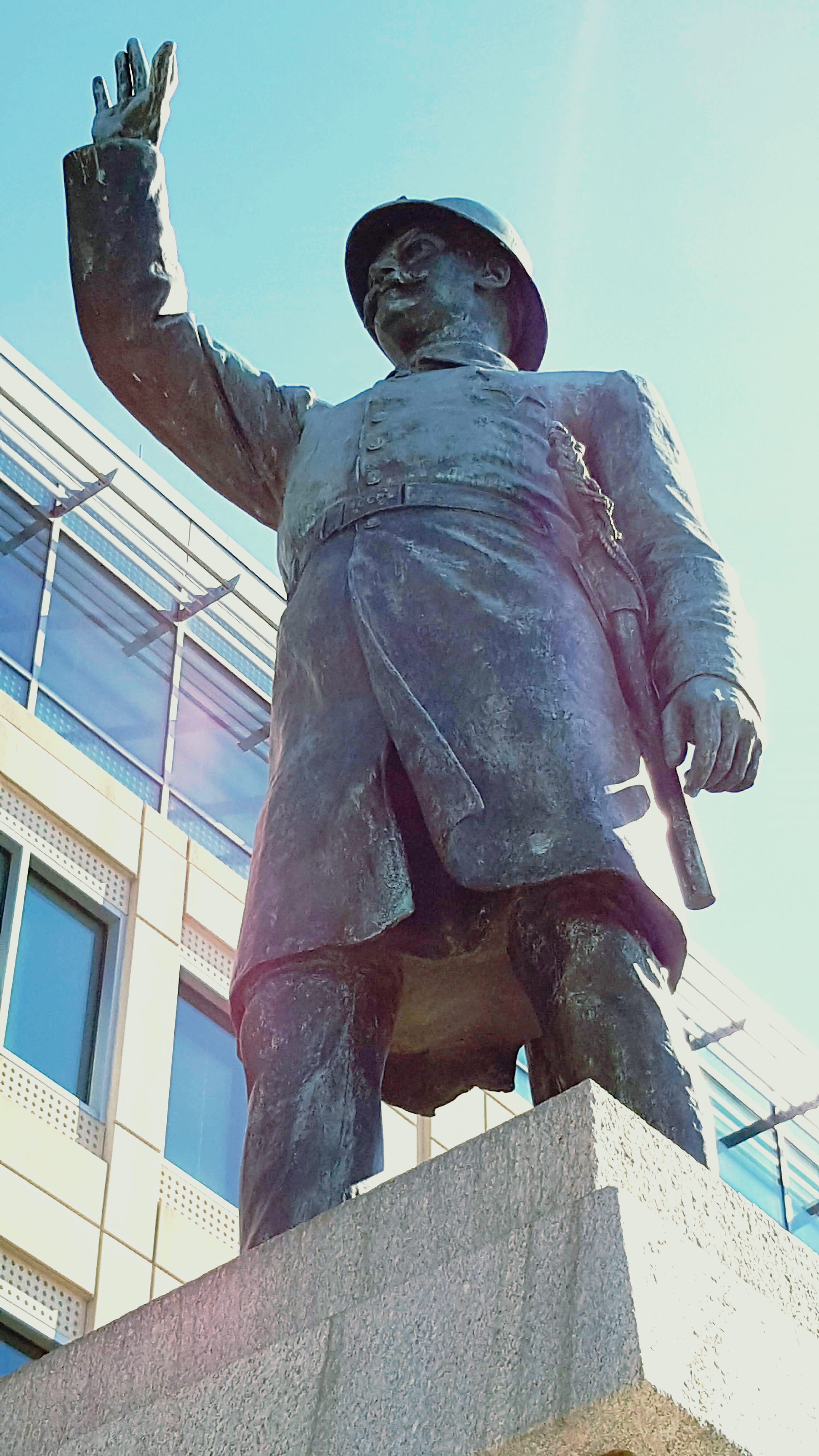
One would think that history etched in iron, bronze and stone would be much harder to edit than the text of history, which is why I found the story of the monument of the “Haymarket Tragedy” (yet another name I found for it) so intriguing. Just as confusing as the name of the historical event, there was not one but three monuments, and they were curiously difficult to find.
Over the course of a century, the statue of Officer Degan had been struck by a derailed streetcar, then it was repaired, relocated, vandalized, bombed, rebuilt, bombed again, relocated, and placed under watch. It was finally rededicated and unveiled in 2007 by the descendants of Officer Degan at Chicago Police Headquarters. It stands in the not-so-public police parking lot on a new pedestal – far from its original pedestal, which had also been defiled for decades before being removed. Conflicting accounts and even a wrong address from an official source had made it confusing to locate the statue – as if it hadn’t already been puzzling to decipher that, besides Officer Degan’s statue, there were in fact two other monuments.
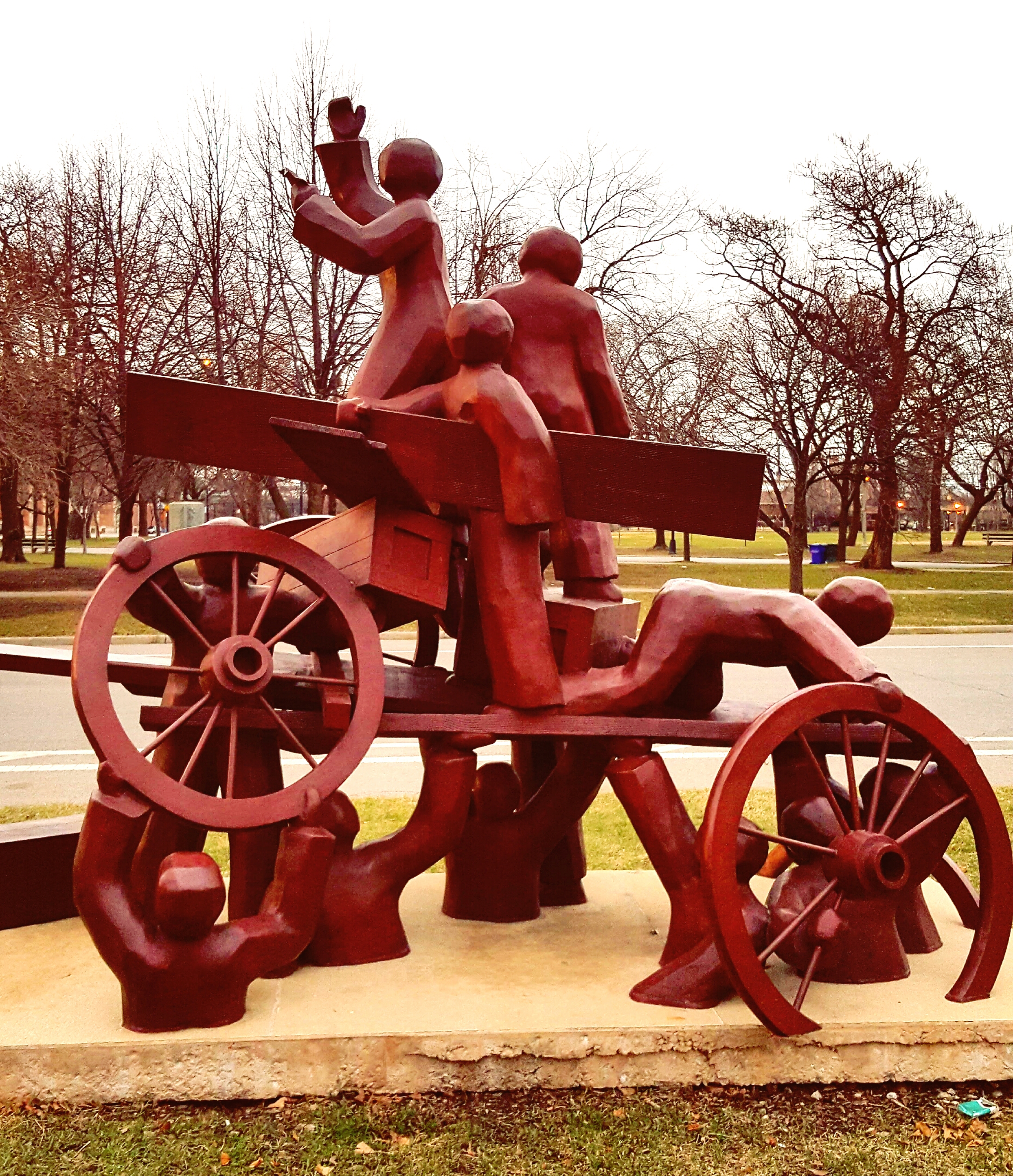
Commissioned by the City of Chicago, the Illinois Federation of Labor History, the Chicago Fraternal Order of Police and the Chicago Department of Transportation, the Haymarket Memorial is a more recent 2004 bronze rendition of the wagon union leaders had stood upon like a pulpit, as imagined by renowned Chicago artist Mary Brogger. It is a fine piece of public art that really captures the emergence of a voice for change on that fatal corner more than a hundred years ago. Oddly, on the occasion of my visit, this monument was yet another that was not where it was supposed to be. When I arrived at the corner of Randolph and Des Plaines, I encountered a construction site with a sign redirecting me to nearby Union Park, where the monument had been “temporarily” relocated to a Washington Blvd median in order to accommodate the construction at its original site. I sincerely hope that relocation was temporary.

The remaining monument was in homage to the fascinating story of the trials and executions that ensued out of a gross travesty of justice. The Martyrs’ Monument is a National Historic Landmark, located in the German Waldheim Cemetery on Circle Ave in Forest Park, where the five defendants were buried and later joined by two more pardoned anarchist defendants. There is a plaque with the inscription of the words attributed to one of the defendants before his hanging: “The day will come when our silence will be more powerful than the voice you are throttling today.”
I hope so.
Because their struggle was much more than a fight over an 8-hour work day. It was about fairness. It was about people obstructed from the pursuit of happiness when having to toil an average of 10 hours per day, six days per week for a $1.50 per day. And although the numbers might be quite different for workers today, I suspect the feeling is not. Furthermore, there is also the same empowered and privileged class that is against unionization, capable of maneuvering to silence dissidents, pitting them against each other, or, in the last instance, pulling the rug out from under them by relocating entire industries to other countries, places where there are no labor rights whatsoever. Slavery never goes away. Never.
“Which brings us to the mess we’ve made of this world”, explained the most intelligent person I know — who I am proud to say is my sister — as we hopped into a cab to head to the South Side to find the statue she had so astutely located. The confusing accounts of the locations and relocations of the monuments were too much information and disinformation for my scattered mind, so I had given it to my sister to sort out. Forget the needle in a haystack: my sister could find a needle in a hay market.
As she pushed me into a cab to head to the Southside, she continued her lecture, explaining to me the schizophrenia behind how those who had championed free markets were now calling for protections from the demons they had created in the first place. She further updated me on how America was changing, how there are actually those clamoring for the right to discriminate against others, for the right not to compensate people equitably for their work, for the right not to recognize how one has benefited from the work of others.
I silenced my sister in my head much like I did the barista, but not because I was uninterested. Seeing once again the magnificence of the city as we headed down Lake Shore Drive to find the statue of Officer Degan, I was contemplating the advantage of the city having burned down in 1871. At the very dawn of Modernity, Chicago hosted World’s Fairs, and has showcased every architectural style since then. If it weren’t for the conflagration, neither Chicago nor the Industrial Revolution would have had such an opportunity to plan and construct a city for its people — workers — complete with the transport, services and public space necessary to enjoy one’s environs. It is such a beautiful city! It is one of the few in world that got enough homework done over a century ago that it still reaps the benefits today.
Despite all the historical hypocrisies of the Gilden Age in which the wealthy lived in the opulence of Streeterville while Black people were redlined into the Southside, and as Jane Adams’s assisted impoverished immigrants on the Westside, the feat of creating a city for workers involved a vision of community, consideration for others whose space must be shared. It took cooperation to create such a world, where individuals gave up some of the fruit of their labor to construct for the benefit of community. In doing so, I’d like to think that some prejudice might have been relinquished as people of different colors and languages encountered each other on the street and in the workplace. Chicago was built by people from all walks of life and the encounter of many cultures. Curiously, such miscegenation may even have resulted in the friendly young officer — a handsome Chicago mix with his dark Mexican features on a big Slavic frame (at least I assumed so from his name tag filled with consonants) — who waived my sister and I through what looked like airport security at Chicago Police Headquarters on the Southside, so that I could finally see the statue in the parking lot.
Officer Degan was oddly placed in a senseless, improvised juxtaposition with the building. Hidden in the insipid parking lot, the location was a far cry from its original, where it stood imposingly, as if directing traffic in Haymarket Square. The discovery reminded me of reencountering the memorabilia one tosses into a closet or garage and forgets.
Due to its controversy, it maybe that the statue was indeed safer there in the parking lot, as, apparently, my sister and I were too, because the friendly officer seemed concerned about our safety on the “Southside”. Having spotted fellow Northsiders, he asked whether we knew where we were going upon exiting. I couldn’t help but to think that the Chicago crisscrossed by borders that my father had to decipher as an immigrant over 60 years ago still exists, together with all the presumed risks of crossing the wrong street at the wrong time. Contemplating such inertia led me to conclude that, just as a streetcar had jumped the tracks to strike the statue for its first fall in Haymarket Square, we have also been derailed from the American project for democracy. A nation that had sought to create a society based on the most elusive and most American of words – fairness – has stagnated into its opposite, a place where people are expected to have work, not livelihoods; medical coverage, not health; education, not knowledge– to say nothing of values.
“A memorial, for what?” I thought, amused at how such a historic monument was only safe when hidden in the police parking lot. Although I’m sure Officer Degan died an innocent man doing his job, I am also sure that the martyrs were innocent men doing their jobs. Looking at the statue in the sunlight of a cold Chicago day, I thought about how the real human tragedy is our inability to hold two truths at the same time. That is why although we will never know who threw that bomb in Haymarket Square, the explosion divided the world irrevocably into two teams, squabbling to own the narrative, both with their own ideas of what fairness means.
The most significant memorials, of course, are the ones that make us reflect, and that is why they always involve art. For me, however, that graffiti face staring back at me in Haymarket Square was more profound than any monument. Since there is no such thing as coincidence, when I saw the tears on the face of that drawing — or black eye, or whatever — I knew it was time to return to Haymarket, as I believe we must all do. It is part of a struggle that has seen many victories, including Suffrage and Civil Rights, but it is an unending tussle that requires constant commitment to renew our vows to fairness, giving equal opportunity for individuals to enjoy the fruits of labor. But there is more. It is a struggle to guarantee the right to a meaningful life, because life has to have space for more than just getting a job, getting married, dying, and then repeating it.
“A decade of strife between labor and industry culminated here in a confrontation that resulted in the tragic death of both workers and policemen. On May 4, 1886, spectators at a labor rally had gathered around the mouth of Crane’s Alley. A contingent of police approaching on Des Plaines Street were met by a bomb thrown from just south of the alley. The resultant trial of eight activists gained worldwide attention for the labor movement, and initiated the tradition of ‘May Day’ labor rallies in many cities.”
Plaque designated on March 25, 1992 by Richard M. Daley, Mayor
http://www.chicagoreader.com/chicago/haymarket-revisited/Content?oid=883396


 ā•multiplicity
Leave a reply to Chicago stories – ā•multiplicity Cancel reply